


Strategy2026-11-1714 min read
How to Predict Football Scores More Accurately: 13 Tips to Beat Your Mates
P
Play Predict Win
Founder and Lead Analyst
Think you know football? From expected goals and team form to tactical matchups and our PlayPredictWin Club Guides, here's how to turn your football knowledge into smarter score predictions.
Every football fan thinks they can predict the weekend's results.
Manchester City at home? Three points. Liverpool away? Goals guaranteed. Manchester United? Well, who knows what you're going to get. But there's a big difference between guessing a result and making an informed football prediction.
Anyone can stick down a 2-1 scoreline. Consistently making good predictions requires something more: research, statistical understanding, football knowledge and the ability to recognise when the obvious result might not be quite so obvious. And that's what separates the casual predictors from the fans regularly climbing the PlayPredictWin leaderboards.
The good news? You don't need to be a professional football analyst or a mathematical genius to improve your predictions.
You just need to know what to look for.
Here are our 13 tips for predicting football scores more accurately.
1. Stop Looking at the League Table in Isolation
Let's start with one of the biggest mistakes football fans make.
Assuming the team higher in the league will win.
It sounds logical. If Arsenal are top and their opponents are sitting 16th, surely there's only one winner? Not necessarily.
League positions tell you what has happened across the season. They don't always tell you how well a team is playing right now. A team sitting fourth might have lost three of its previous five matches. Meanwhile, a team in 14th could be unbeaten in six and playing some of its best football of the season.
Look beyond the table.
Consider:
- ·Results from the previous five to ten matches.
- ·Goals scored and conceded during that period.
- ·The quality of the opposition faced.
- ·Whether performances are improving or declining.
- ·Home and away form.
PPW Prediction Tip: Recent form is useful, but don't ignore the bigger picture. Five matches can reveal a trend, but they can also produce misleading conclusions.
2. Use the PlayPredictWin Club Guides Before Making Your Predictions
Here's something that can give you a head start before you've even selected a scoreline.
The PlayPredictWin Club Guides.
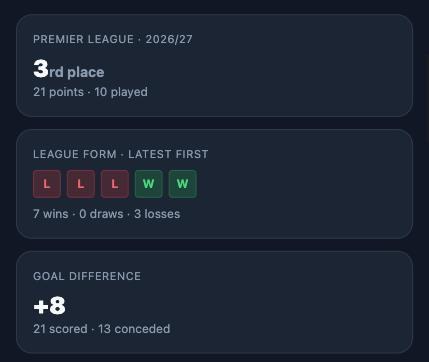
We've built dedicated pages for Premier League clubs to give supporters useful information about their teams, upcoming fixtures and performances. Rather than jumping straight into a prediction, take a couple of minutes to research the teams involved.
Our club pages bring together information including:
- ·Current Premier League position and points.
- ·Recent league form.
- ·Goals scored and conceded.
- ·Goals per game.
- ·Clean sheets and matches without scoring.
- ·Recent results.
- ·Upcoming fixtures.
- ·Opposition comparisons.
- ·Predictions submitted by fellow PlayPredictWin users.
It's a useful starting point for anyone wanting to make more informed predictions.
How to use the Club Guides effectively
Imagine Tottenham are preparing to face Manchester City.
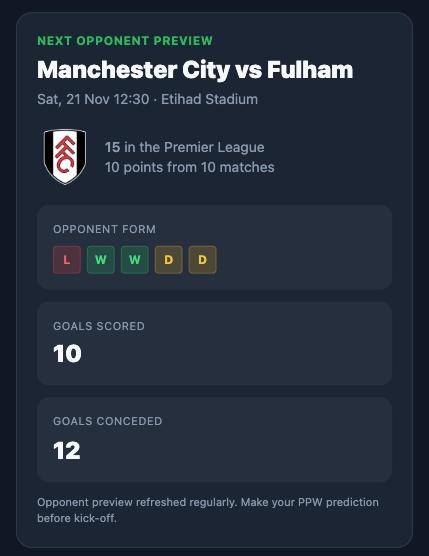
Start by looking at Tottenham's club page. How many goals have they scored recently? Are they keeping clean sheets? Is their recent form improving?
Next, investigate Manchester City's performances. Are they scoring consistently? Have they struggled defensively? How do the two teams compare?
Then look at the upcoming fixture information and the predictions being made by other supporters. You might discover that a team with a relatively modest league position has been performing considerably better than its results suggest. Or that a supposedly straightforward away victory looks much less certain when you examine the opposition.
Don't overlook the supporter predictions
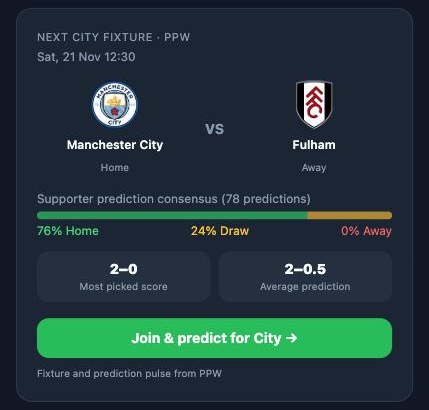
One of the more interesting features of our club pages is the supporter prediction consensus.
For upcoming fixtures, you can see how participating PlayPredictWin users expect the match to unfold, including the most popular predicted scoreline. It's a fascinating insight into what other football fans are thinking. But remember: the most popular prediction isn't automatically the correct one. Supporters can be influenced by club loyalty, reputation and recent results. Use the consensus as another piece of information, not as your final answer.
PPW Prediction Tip: Check the Club Guides for both teams before making your prediction. A few minutes of research could highlight something you've overlooked.
3. Home Advantage Still Matters
There's a reason football supporters talk about making their stadium a fortress. Home advantage is a real phenomenon in football, although its strength varies between clubs and competitions. Familiar surroundings, reduced travelling, crowd support and tactical confidence can all contribute. But here's where it gets interesting.
Not every team enjoys the same level of home advantage. Some sides are formidable on their own ground but struggle badly on their travels. Others are perfectly comfortable playing away, particularly teams whose counter-attacking style suits opponents who push forward.
What should you check?
Look at:
- ·Home wins, draws and defeats.
- ·Away wins, draws and defeats.
- ·Average home goals scored.
- ·Average away goals scored.
- ·Clean sheets at home and away.
- ·The strength of the opposition faced.
A team averaging two goals per home match might justify a very different prediction from the same team playing away against a strong defensive side.
PPW Prediction Tip: Always assess home and away performances separately. Overall league form can disguise some important differences.
4. Understand Expected Goals (xG)
If you're serious about improving your football predictions, it's worth understanding expected goals. Don't worry. You won't need a calculator the size of Wembley. Expected goals, or xG, measures the estimated likelihood of a scoring opportunity resulting in a goal.
A shot from six yards in front of goal is generally more likely to result in a goal than a speculative effort from 30 yards. Statistical models assign probabilities to these opportunities based on factors such as distance, angle and the type of chance created.
For example:
- ·A clear chance close to goal might have an xG of 0.60.
- ·A difficult effort from outside the penalty area might have an xG of 0.03.
These are illustrative values; actual figures depend on the model and circumstances.
Why does this matter?
Imagine a team wins 2-0 despite creating very few good opportunities. Their opponents dominate possession and create several excellent chances but fail to score. The result suggests a comfortable victory. The underlying performance tells a different story. Over several matches, xG can help identify teams whose results are better or worse than their chance creation suggests.
However, there's an important distinction. A team outperforming its xG isn't automatically due to start losing. Some teams have particularly effective finishers, while chance quality, opposition and tactical factors all matter.
PPW Prediction Tip: Use xG alongside actual goals, recent performances and opposition quality. It's a useful tool, not a crystal ball.
5. Compare Attacking Strength Against Defensive Weakness
Football matches aren't played on spreadsheets. But statistics can help you identify where one team might have an advantage over another.
Consider two hypothetical teams:
| Statistic | Team A | Team B |
|---|---|---|
| Goals scored per match | 2.1 | 1.2 |
| Goals conceded per match | 0.9 | 1.8 |
| Clean-sheet percentage | 40% | 20% |
Illustrative statistics.
Team A looks considerably stronger. But what if Team B has recently changed manager, improved defensively and kept three clean sheets in its previous four matches? Suddenly, the prediction becomes less straightforward. That's why it's important to combine season-long statistics with recent performances.
Look for attacking and defensive mismatches
A team that creates plenty of chances against an opponent conceding numerous opportunities could be worth considering for multiple goals. Likewise, two defensively organised teams with limited attacking output might produce a lower-scoring contest.
PPW Prediction Tip: Don't just ask who will win. Ask how many chances each team is likely to create and how effectively the opposition can defend them.
6. Team News Can Change Everything
You've done your research. You've studied the statistics. You're convinced the home team will win 3-1. Then the starting line-ups are announced. Their leading goalscorer is missing, the first-choice goalkeeper is injured and the manager has rested three midfielders. Suddenly, that 3-1 prediction doesn't look quite so convincing. Team news is one of the most important factors in football forecasting.
Pay particular attention to:
- ·Injuries to influential players.
- ·Suspensions.
- ·Expected starting line-ups.
- ·Squad rotation.
- ·Changes in formation.
- ·Players returning from injury.
Not every absence has the same impact. Losing a key creative midfielder might significantly affect a team's attacking output, while a well-equipped squad could replace a missing defender without much disruption.
PPW Prediction Tip: Make an early assessment, but check reliable team news before kick-off. On PlayPredictWin, you can update your score prediction before the match locks.
7. Fixture Congestion: The Hidden Factor
Playing three matches in eight days is very different from having an entire week to prepare.
Teams competing in the Premier League, Champions League, Europa League and domestic cups face demanding schedules. And those schedules can influence performance.
Consider a club playing away in Europe on Thursday before returning to Premier League action on Sunday. The manager might rotate players, change the tactical approach or ask the team to conserve energy.
However, don't assume every team playing in Europe will struggle domestically. The biggest clubs often have deeper squads capable of managing demanding schedules.
What to look for
- ·Days since the previous match.
- ·European travel commitments.
- ·Recent playing time for key players.
- ·Squad depth.
- ·Upcoming important fixtures.
- ·Whether the manager regularly rotates.
PPW Prediction Tip: Check both teams' schedules. The side with more recovery time may have an advantage, particularly when the opposition has a limited squad.
8. Learn the Difference Between Predicting a Winner and Predicting a Score
Here's where things get particularly interesting.
Predicting that Arsenal will beat Everton is one thing. Predicting Arsenal will win exactly 2-1 is something entirely different. A team can win by numerous possible scorelines. Even when a home victory is relatively likely, no single correct score may be particularly probable.
The mathematics behind correct-score predictions
One common statistical technique is the Poisson distribution. It estimates the probability of a team scoring a particular number of goals based on its expected scoring rate. Imagine a hypothetical match where a model estimates:
- ·Home team: 1.8 expected goals.
- ·Away team: 0.9 expected goals.
Using a basic independent Poisson model, the approximate probabilities are:
| Scoreline | Probability |
|---|---|
| 1-0 | 12.1% |
| 2-0 | 10.9% |
| 1-1 | 10.9% |
| 2-1 | 9.8% |
| 0-0 | 6.7% |
Illustrative calculations, not a forecast for a real fixture.
Notice something?
Even the most likely individual scoreline has only around a 12% probability. That's why exact-score prediction is so difficult. And it's also why getting one right feels so satisfying. More advanced models can account for additional factors, including relationships between low-scoring results, but the principle remains the same.
PPW Prediction Tip: Consider several plausible scorelines before choosing your final prediction. A confident home win doesn't necessarily mean a comfortable 3-0 victory.
9. Don't Get Carried Away With Head-to-Head Records
You've probably heard statistics like these:
"United haven't won at this ground for ten years."
"Liverpool have won their last six meetings."
"Arsenal always struggle against this opposition."
Interesting? Absolutely.
Decisive? Not necessarily.
Football clubs change constantly. Managers come and go. Players move. Tactical systems evolve. A result from eight years ago involving two completely different squads may have little relevance to the upcoming fixture. Head-to-head statistics can still be useful, particularly when recent encounters reveal recurring tactical problems. But they shouldn't dominate your prediction.
PPW Prediction Tip: Give greater weight to current performances and recent tactical matchups than historical results involving different managers and players.
10. Understand How Teams Actually Play
Two teams might have identical league records but completely different playing styles.
And those styles can influence the likely result. For example:
High pressing against possession football
A side that presses aggressively might create opportunities against opponents who struggle to play out from defence.
Counter-attacking against a high defensive line
A team with quick forwards could exploit the space left behind an opponent's defence.
Set-piece specialists against poor set-piece defenders
Corners and free kicks can become particularly important when one team struggles to defend aerial deliveries.
Defensive organisation against attacking possession
A compact defensive side might frustrate a technically superior opponent and reduce the number of clear chances.
These tactical details can help explain why the better team doesn't always win.
PPW Prediction Tip: Think about how the teams' playing styles interact, not simply which club has the stronger squad.
11. Take Your Club-Coloured Glasses Off
This might be the hardest tip of them all.
Especially if you're predicting your own team.
Football supporters are naturally optimistic about their clubs. A Manchester United fan might convince themselves that a difficult away fixture is perfectly winnable. An Arsenal supporter might struggle to imagine their team dropping points at home. And a Liverpool fan might confidently predict three goals because their attack looked brilliant the previous weekend.
There's nothing wrong with supporting your club. But emotional attachment can influence your judgement.
Common prediction mistakes
Recency bias: Assuming a team will keep winning because it won its last match convincingly.
Reputation bias: Overestimating a club because of its history or reputation.
Confirmation bias: Looking only for statistics that support the result you already want.
Overconfidence: Treating a plausible prediction as though it's almost certain.
A good way to avoid these mistakes is to make an initial prediction before looking at what other supporters think. Then compare it with the evidence.
PPW Prediction Tip: Apply the same standards to every team. Your club doesn't deserve an extra goal just because you love them.
12. Learn From Your Mistakes
Here's a question.
When your prediction is wrong, do you investigate why?
Or do you simply blame the referee and move on? If you want to improve, reviewing previous predictions is essential. Suppose you predict a 3-0 home victory, but the match finishes 1-1.
What went wrong?
Perhaps you underestimated the away team's defence. Maybe the home side struggled to create chances. Or perhaps your prediction was perfectly reasonable, but the match was influenced by an early red card.
Football is unpredictable. Sometimes good predictions fail and poor predictions succeed. The important thing is to assess the quality of your decisions over time.
Track your prediction performance
Look at:
- ·How often you predict the correct result.
- ·How often you predict the exact score.
- ·Whether you overestimate the number of goals.
- ·Whether you're better at predicting certain teams.
- ·How frequently you correctly identify draws.
- ·Whether your performance improves over the season.
At PlayPredictWin, your predictions earn points and contribute towards your leaderboard position, giving you a way to follow your progress.
PPW Prediction Tip: Don't judge your football knowledge on one weekend. Review your results across an extended period.
13. Use Your Double Up Wisely
Now here's something particularly relevant to PlayPredictWin.
Our Double Up feature gives you the opportunity to double your points on one selected match each gameweek.
Normally, you earn:
- ·3 points for predicting the exact score.
- ·1 point for predicting the correct match result.
- ·0 points for an incorrect prediction.
With Double Up, those potential rewards become:
- ·6 points for an exact score.
- ·2 points for the correct result.
That makes choosing your Double Up match an important part of your weekly strategy.
Which match should you choose?
It's tempting to select the biggest fixture of the weekend.
Manchester City against Liverpool? Brilliant entertainment. But is it necessarily the best match to Double Up? Not always. A match involving a strong favourite against weaker opposition might offer a higher probability of correctly predicting the winner.
However, a likely winner doesn't automatically make the exact score easier to predict. The best choice depends on how confident you are in both the match outcome and the likely scoreline.
Think about expected points
For a particular predicted score, a useful way to evaluate your choice is:
Expected points = (3 × probability of exact score) + (1 × probability of correct result but wrong score)
For example, suppose your estimates suggest:
- ·15% chance of predicting the exact score.
- ·45% chance of predicting the correct result but not the exact score.
- ·40% chance of an incorrect result.
Your expected points would be:
(3 × 0.15) + (1 × 0.45) = 0.90 points
With Double Up, that becomes 1.80 expected points.
These are hypothetical probabilities, but they demonstrate the principle. If your aim is to maximise expected points, choose the match with the highest estimated expected score under the competition's rules. And remember, your Double Up selection locks at the first kick-off of the PPW gameweek.
PPW Prediction Tip: Don't automatically Double Up the biggest match. Look for the fixture where your research gives you the strongest overall prediction.
Can AI Predict Football Scores Better Than Fans?
Artificial intelligence is changing the way football data is analysed. Modern forecasting models can examine historical results, team strength, scoring patterns and other variables to estimate the probabilities of different outcomes.
But can AI actually outperform football supporters?
That's a much more interesting question. Because football isn't played by algorithms.
A model might identify statistical patterns that a human overlooks, but supporters can also recognise tactical changes, unusual team news and contextual factors that aren't captured in the data. And even the best model will get plenty of results wrong.
Meet Botty McBotface
At PlayPredictWin, we've introduced Botty McBotface, our resident AI football predictor.
Botty's challenge is simple.
Predict football results and see how those predictions compare with what actually happens on the pitch. Can artificial intelligence outperform passionate supporters? Can football fans beat the machine? And who will be celebrating when the final whistle blows?
We'll be following Botty's predictions and results to find out. It's another way to test whether statistical analysis or human football knowledge comes out on top.
The PlayPredictWin Match Prediction Checklist
Before submitting your next predictions, run through this simple checklist.
1. Check the league table
Where do both teams stand, and how have they performed across the season?
2. Visit the PlayPredictWin Club Guides
Research both clubs, their recent results, goals scored, goals conceded and upcoming fixtures.
3. Analyse recent form
Look beyond wins and losses. Consider the quality of performances and opposition.
4. Compare home and away records
Is the home team particularly strong at its own ground? Does the away side struggle on the road?
5. Consider expected goals
Are the teams consistently creating and conceding good opportunities?
6. Check team news
Are important players missing? Is the manager likely to rotate?
7. Review fixture congestion
Has either side had significantly less recovery time?
8. Think about tactics
Which team is better equipped to exploit the other's weaknesses?
9. Consider the likely scoreline
Don't simply pick the winner. Think about the number of goals each side is likely to score.
10. Check the supporter consensus
See what other PlayPredictWin users are predicting, but make your own decision.
11. Choose your Double Up
Identify the match where you believe your prediction offers the strongest opportunity to earn points.
12. Submit before kick-off
Make sure your predictions are saved before the relevant deadlines. It might sound like a lot of preparation, but once you develop a routine, the process becomes much quicker. And that's when predicting football scores becomes even more enjoyable.
Frequently Asked Questions About Football Score Predictions
What is the best way to predict football scores?
The best approach is to combine recent team form, attacking and defensive statistics, home advantage, team news and tactical analysis. Using the PlayPredictWin Club Guides provides a useful starting point for researching upcoming fixtures.
Can you predict football scores using mathematics?
Yes. Statistical techniques such as the Poisson distribution can estimate the probability of different scorelines based on expected goals. However, these models provide probabilities rather than guaranteed outcomes.
How accurate are correct-score predictions?
Exact-score predictions are difficult because many different results are possible. Even the most likely individual scoreline may have a relatively low probability of occurring.
Is expected goals (xG) useful for football predictions?
Yes. Expected goals helps measure the quality of scoring opportunities created and conceded. It can provide additional insight beyond actual results, particularly when analysed over multiple matches.
How can I improve my Premier League predictions?
Research both teams, compare recent performances, check home and away form, monitor team news and review your previous predictions. Avoid relying solely on league position or club reputation.
Should I follow other fans' predictions?
Other supporters' predictions can provide useful context, particularly when many people are predicting the same result. However, popular opinion can be wrong, so it's important to carry out your own research.
Can AI predict football scores accurately?
AI models can analyse large amounts of football data and estimate outcome probabilities. Their accuracy depends on the model, data quality and competition. No AI system can guarantee correct scores.
Can I predict football scores without betting?
Absolutely. PlayPredictWin is a free-to-enter football prediction competition where supporters aged 18 and over can predict scores, earn points, compete with friends and win prizes without placing bets.
Final Whistle: Better Research, Better Predictions
So, what's the secret to predicting football scores more accurately?
There isn't one magic statistic or guaranteed formula. The best approach is to combine football knowledge with relevant data, understand the strengths and weaknesses of both teams and avoid letting emotion dictate your predictions. Use recent form. Study the statistics. Check team news. Understand tactical matchups. And make the most of the PlayPredictWin Club Guides to research your teams before every gameweek.
Most importantly, learn from your previous predictions. You won't get every score right. Nobody does. But by following a consistent process, you can make better-informed decisions and give yourself a stronger chance of climbing the leaderboard.
Think You Know Football? Prove It.
At PlayPredictWin, we believe football knowledge deserves more than just bragging rights.
Predict the scores of Premier League matches and selected European and domestic cup fixtures, compete against fellow supporters and put your football knowledge to the test.
It's completely free to enter for players aged 18 and over. And there are real prizes up for grabs.
Current advertised prizes include:
- ·£50 weekly first prize
- ·£100 monthly first prize
- ·£500 season champion prize
You can also create private leagues with friends, represent your favourite club in the Supporter League and see whether your predictions are better than Botty McBotface's.
No betting. No entry fees. Just football knowledge, friendly rivalry and the chance to win.
You've read the guide. You've done your research. Now it's time to make your predictions.
18+. Free to enter. Competition rules apply.
Further Reading and Research
For supporters interested in the statistical foundations of football prediction:
- ·Dixon, M. J. and Coles, S. G. (1997). Modelling Association Football Scores and Inefficiencies in the Football Betting Market. Journal of the Royal Statistical Society: Series C, 46(2), 265–280.
- ·Karlis, D. and Ntzoufras, I. (2003). Analysis of Sports Data by Using Bivariate Poisson Models. The Statistician, 52(3), 381–393.
- ·PlayPredictWin: How to Predict Every Premier League Scoreline Like a Pro
- ·PlayPredictWin: Premier League 2026/27 Prediction Guide
PlayPredictWin provides football analysis and free prediction competitions. All forecasts involve uncertainty, and no method guarantees an exact result.
Ready to test your prediction skills?
Join the Prediction League →